

TL;DR overview
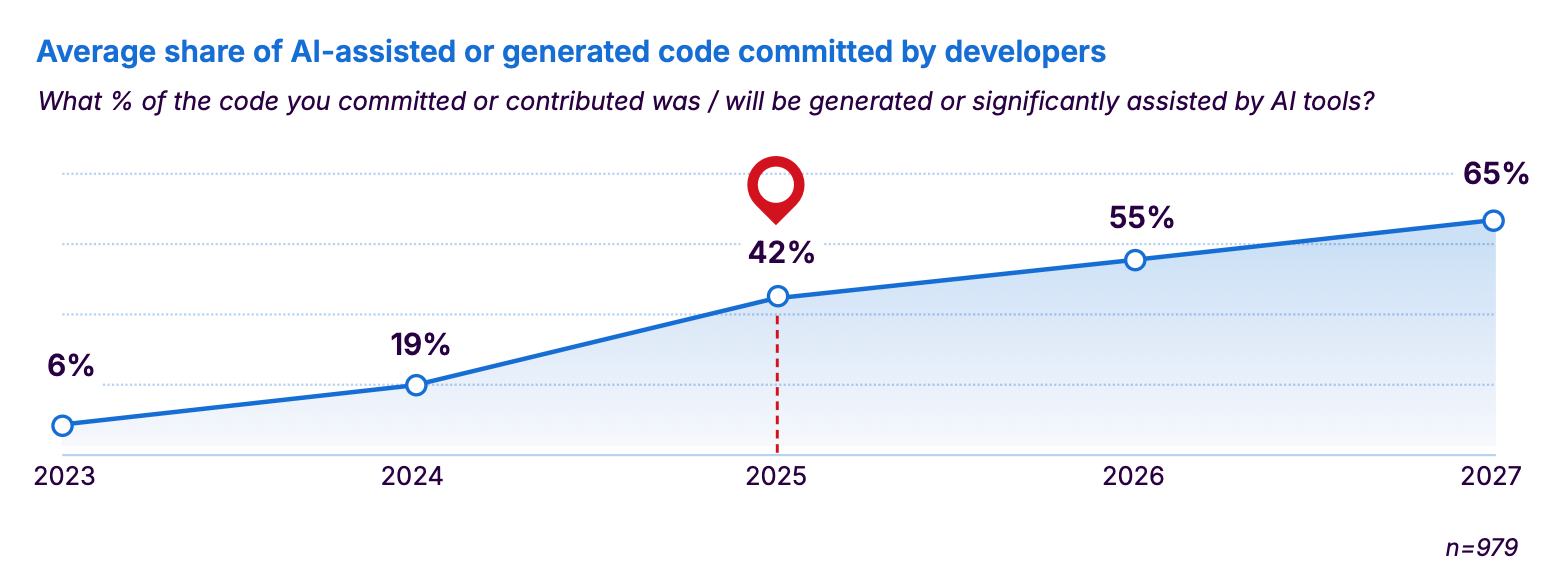
- Sonar's 2026 State of Code Developer Survey of over 1,100 professional developers finds that AI accounts for 42% of committed code today and is expected to reach 65% by 2027—but 96% of developers do not fully trust AI-generated code, and only 48% always verify it before committing.
- Rather than delivering a direct productivity boost, the surge in AI-generated code has created a verification bottleneck: 38% of developers report that reviewing AI code requires more effort than reviewing code written by human colleagues.
- SonarQube users report substantially stronger outcomes—including positive impacts on code quality, rework costs, and defects—than non-users, and are 44% less likely to experience outages caused by AI-generated code.
- The survey identifies verification as the critical differentiator in extracting real productivity from AI: organizations that pair rapid AI generation with automated quality and security checks achieve speed without accumulating hidden reliability risks.
Sonar analyzes over 750 billion lines of code every day. This gives us a unique, high-level view of the state of code quality and security across the globe. We can see the trends in the code itself, but to truly understand the state of software development, we need to understand the people writing it.
To get this on-the-ground perspective, we launched the State of Code Developer Survey. We surveyed more than 1,100 professional developers to understand how their daily work is changing—specifically in the wake of the AI coding boom. We wanted to move beyond the hype and get a read on the reality: the efficiencies, the frustrations, and the new workflows that are actually emerging in engineering teams today.
What we found challenges the common narrative. While AI adoption is massive, it hasn’t led to a simple, linear boost in productivity. Instead, it has created a new bottleneck at the verification stage, with more work now required to review code.
Here is a look at the key findings from the first chapter of our report, focusing on how developers are really using AI today.
AI is now a daily habit, not an experiment
The era of experimenting with AI on the weekends is over. AI-assisted coding has officially become a standard part of the professional workflow.
Our data shows that 72% of developers who have tried AI coding tools now use them every day.
This isn't just about chatting with a bot to debug an error message. It represents a fundamental shift in how software is being built. Developers report that 42% of the code they commit is currently AI-generated or assisted.
This volume is only going to grow. Developers predict that the share of AI-generated code in their codebase will increase by over half by 2027.
AI is being used for everything, everywhere
Many believe that AI is only used for experimentation, prototypes or side projects. Our survey indicates that AI has moved far beyond that, permeating every layer of software development.
Developers are using AI across the entire gamut of projects:
- 88% use it for prototypes and proofs of concept
- 83% use it for internal, non-critical production software
- 73% use it for customer-facing applications
- 58% use it for business-critical or mission-critical services
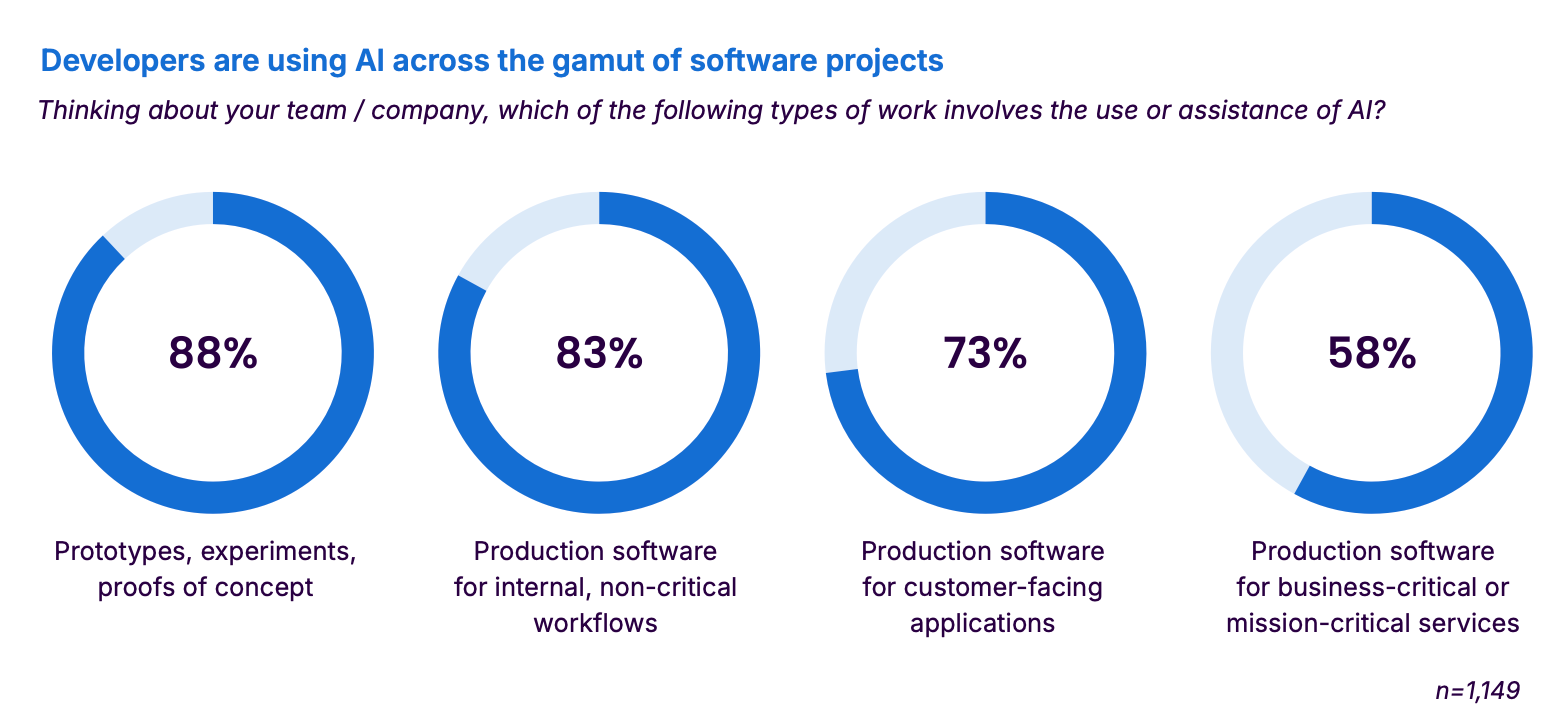
This broad adoption suggests that organizations are no longer dipping their toes in the water; they have jumped in headfirst.
There is a gap between usage and effectiveness
While usage is high, effectiveness varies significantly depending on the task. We found a distinct gap between how often developers use AI for a task and how effective they actually find it.
For instance, the most common use case for AI is assisting with new code development, with 90% of developers using it for this purpose. However, only 55% of those users rated AI as "extremely or very effective" for that specific task. Similarly, while 72% use AI for refactoring, only 43% find it highly effective.
Where does AI truly shine? According to developers, AI performs best when it is working with existing context or generating boilerplate materials. The highest effectiveness ratings went to:
- Writing documentation (74% effective)
- Explaining or understanding existing code (66% effective)
- Generating tests (59% effective)
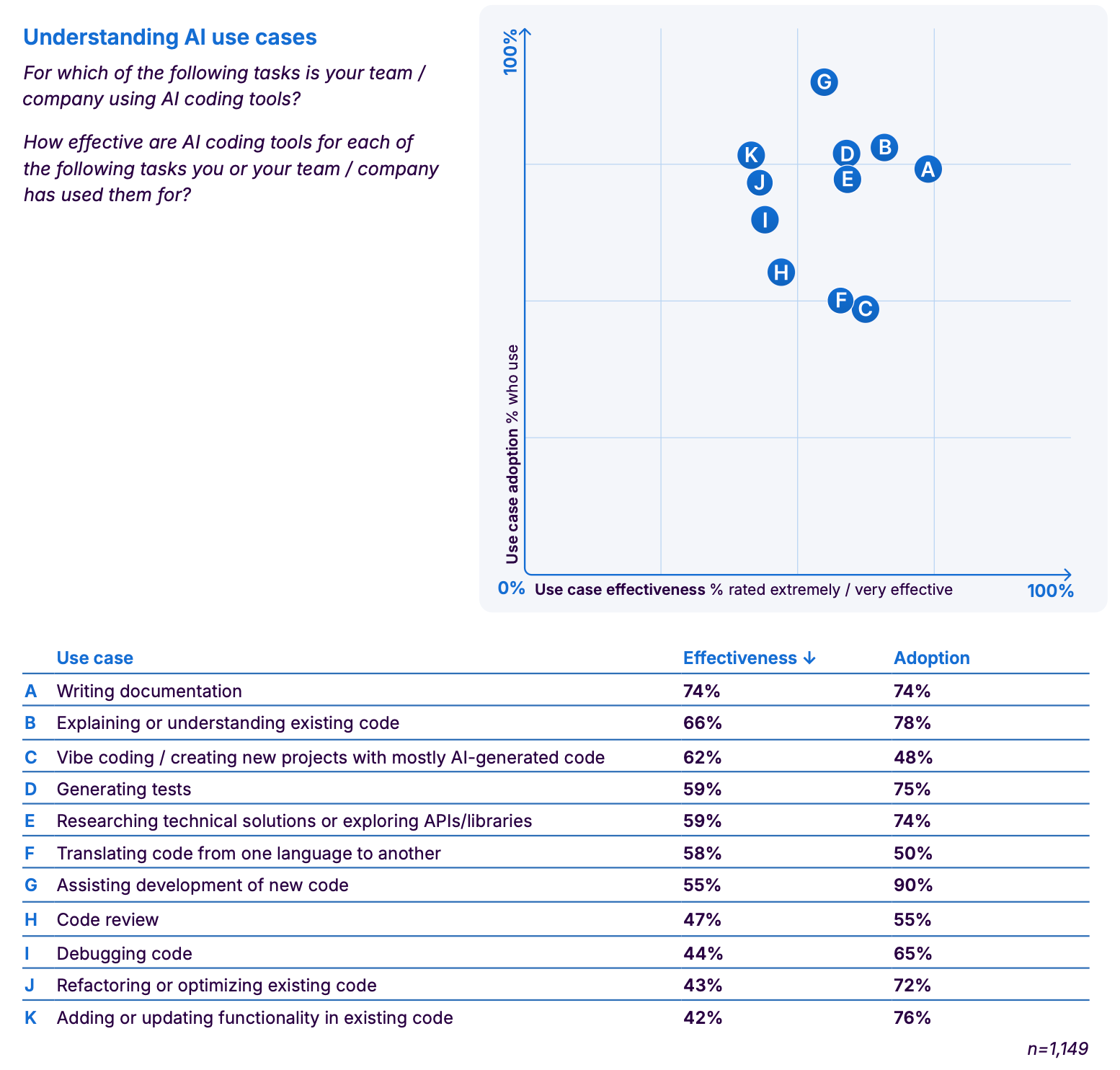
Developers are pragmatic. They view AI as a powerful "explainer" and "prototyper," but they still see gaps in its ability to handle the nuanced, complex work of refactoring or maintaining mission-critical systems without close supervision. This gap between high usage and selective effectiveness isn't just about features—it's about confidence. When the stakes are high, how much do developers really trust the code AI generates?
Read the full report
This is just the beginning of the story. The full State of Code Developer Survey report dives deeper into the consequences of this shift, including the emerging "verification bottleneck," the impact on technical debt, and the surprising split in attitudes between junior and senior developers.
