
TLDR overview
- Sonar Vortex connects Devin Desktop to SonarQube's full analysis engine, delivering your project's coding guidelines and architectural constraints to Devin Local before it writes code, and analyzing every edit the moment it lands.
- Vortex fits teams running Devin Desktop local sessions against a codebase that SonarQube already analyzes in CI, who want project standards enforced during active code generation rather than after a pull request triggers a pipeline.
- Verification inside the agent loop returns CI-depth findings in seconds, so the agent corrects its own output before a human opens a diff.
- Setup installs the plugin with
devin plugins install, authenticates to SonarQube, and writes a global integration to~/.config/devin/that applies across every project and is shared with Devin CLI.
Sonar Vortex delivers project-aware context and constraints to AI coding agents and runs SonarQube analysis inside the agent's loop, and in Devin Desktop you enable it through a dedicated SonarQube plugin. Coding agents generate code without knowledge of a project's established standards, architectural boundaries, or issue history, and oftentimes nothing verifies their output until CI runs after a pull request is opened. This blueprint configures Vortex inside Devin Desktop to supply context before the agent writes and trigger verification as it writes: installing the plugin, running the integration, reviewing what the integration configured in the Customize panel, guiding the agent with context and constraints, verifying the agentic loop on a real edit, and running multi-file DEEP analysis from the terminal. Every example in this guide runs against a fork of the aws-cli project, a large Python codebase.
When to use this
You want Devin Desktop to abide by your project's existing coding standards and catch issues as it writes code, not after a pull request triggers CI. Reach for this blueprint when:
- You run Devin Desktop local sessions (Devin Local), in the Agents or IDE view, against a codebase that SonarQube already analyzes.
- You want the agent following your project's conventions instead of generic language defaults.
- You want issues surfaced inside the agentic coding loop rather than by a CI-blocked pull request.
This blueprint covers the Devin Desktop plugin path in Local mode. If you're configuring Vortex directly from the SonarQube CLI instead, consult the Install Vortex for Devin guide, which documents both paths. For terminal-based workflows, see Set up the SonarQube plugin for Devin CLI.
What you'll achieve
- The SonarQube plugin installed for Devin Desktop, with dedicated
sonar-*skills available as/sonarqube:slash commands and listed in the Customize panel. - A global integration in
~/.config/devin/that registers the SonarQube MCP Server (sonar run mcp), secrets hooks, Vortex hooks, and anAGENTS.mdinstruction block. - Working skill calls, a verified secrets block on a file read, and end-of-turn
DEEPanalysis on code the agent writes.
Architecture
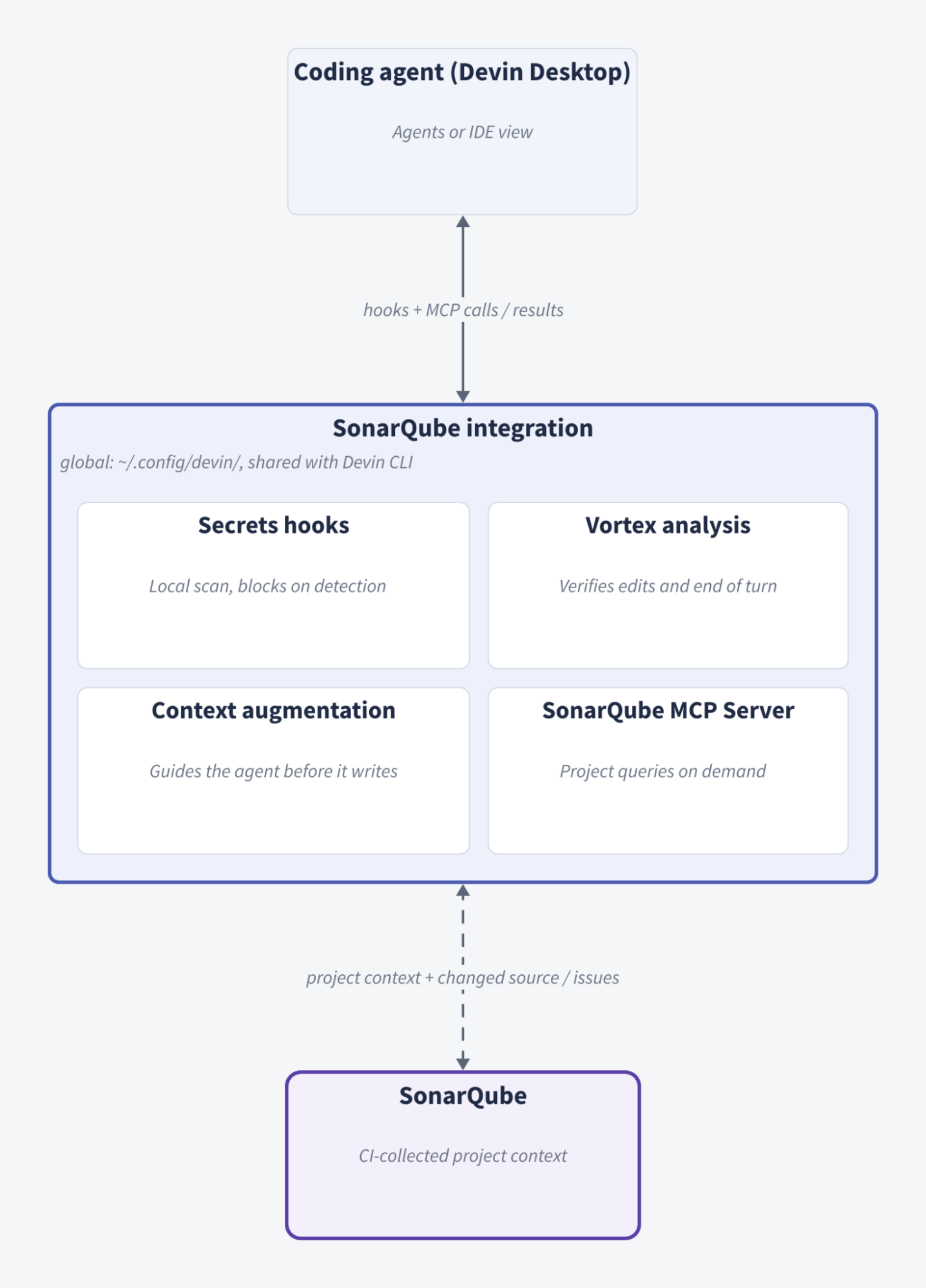
The integration is split across two layers, and Devin Desktop shares both with Devin CLI. Devin Local is the same agent harness the CLI uses, so plugins, skills, hooks, and MCP servers follow the same formats and discovery paths in either one.
The plugin layer contributes skills, but owns no runtime infrastructure and ships no hooks. You install it from SonarSource/sonarqube-agent-plugins, and its skills surface as /sonarqube: commands, including /sonarqube:sonar-integrate.
The SonarQube CLI layer does the work. sonar auth login holds your authenticated session in the OS keychain. sonar run mcp starts the SonarQube MCP Server container, which Devin talks to over stdio. Each SonarQube hook installed for Devin is a short wrapper around a sonar hook command. The hooks use the CLI’s active credentials, so you don’t need a separate login for each hook.
The integration registers five hooks in ~/.config/devin/config.json:
The install is global. It writes to ~/.config/devin/ on macOS and Linux, nothing goes into your project, and the CLI offers no project-scoped mode. The end-of-turn DEEP pass isn't a hook. It comes from a managed block in ~/.config/devin/AGENTS.md that instructs the agent to run it.
Vortex context doesn't travel the MCP path. It reaches Devin through the SessionStart and subagent hooks and runs through the local sonar context tool, so you won't see context tools in your MCP tool list.
The analysis is fast enough to sit in a coding loop because it doesn't recompute anything. A CI run stores your project's dependencies, compiled artifacts, type information, and build configuration, tagged by project key and branch. Vortex restores that context on demand, so a single-file check returns in seconds.
Vortex covers the Guide and Verify stages of Sonar's Agent Centric Development Cycle: it guides the agent with project-aware context and constraints, then verifies the agent's output with CI-level precision.
Prerequisites
- Devin Desktop installed and authenticated, with Devin Local selected as the agent for new conversations (App settings → Agents → Devin Local → Enabled)
- The workspace is not in Restricted Mode, because hooks don't load or run there
- The
devincommand available in a terminal, for the plugin management commands (devin plugins), with plugins permitted by your organization - SonarQube Cloud on Enterprise, or Team with an annual plan, or SonarQube Server 2026.5 or later on Enterprise or Data Center edition
- A Sonar Vortex subscription active for your organization; secrets scanning and the remaining skills still work without it
- A container runtime operational: Docker, Podman, or nerdctl. The MCP server runs as a container
- (Optional) SonarQube CLI (
sonar) 1.11.0 or later. Thesonar-integrateskill installs or updates it, so you can skip this going in. This blueprint was written against version 1.12.0 - (Optional) A
sonar-project.propertiesfile in the project root. The skills use it to resolve the project key
To follow along exactly, fork aws/aws-cli, import it into SonarQube Cloud with CI-based analysis, and analyze it on a long-lived branch through CI. Both Vortex capabilities restore stored CI context; without a prior run, results may degrade.
Step 1 — Install and activate the plugin
In a terminal (or the integrated terminal in Devin Desktop), install the plugin from the repository:
devin plugins install SonarSource/sonarqube-agent-pluginsConfirm it's installed:
devin skills list
devin plugins list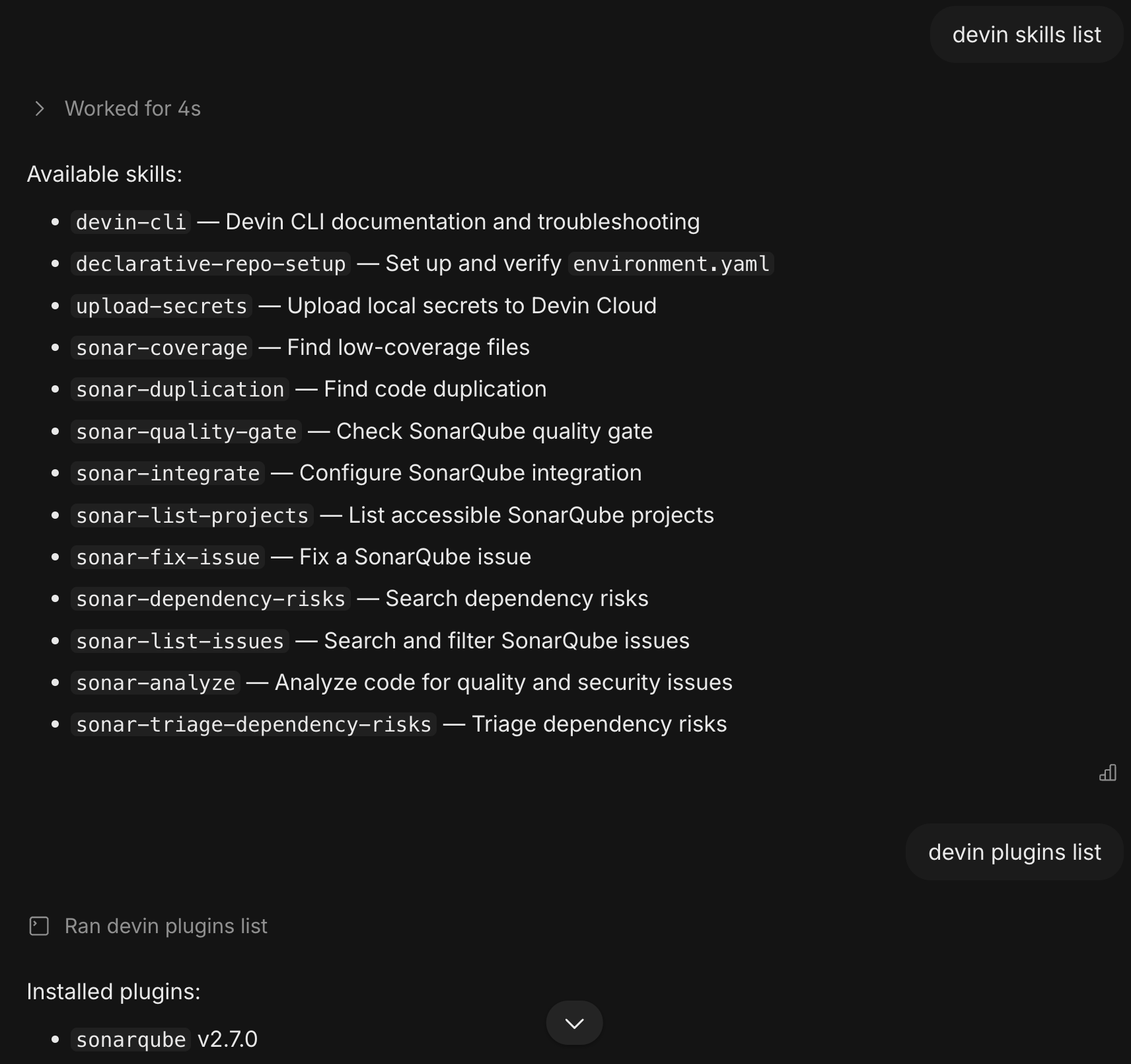
In Devin Desktop, open the Customize tab from the agent sidebar in the Agents view. The Plugins tab lists sonarqube, and the Skills tab lists its sonar- skills.
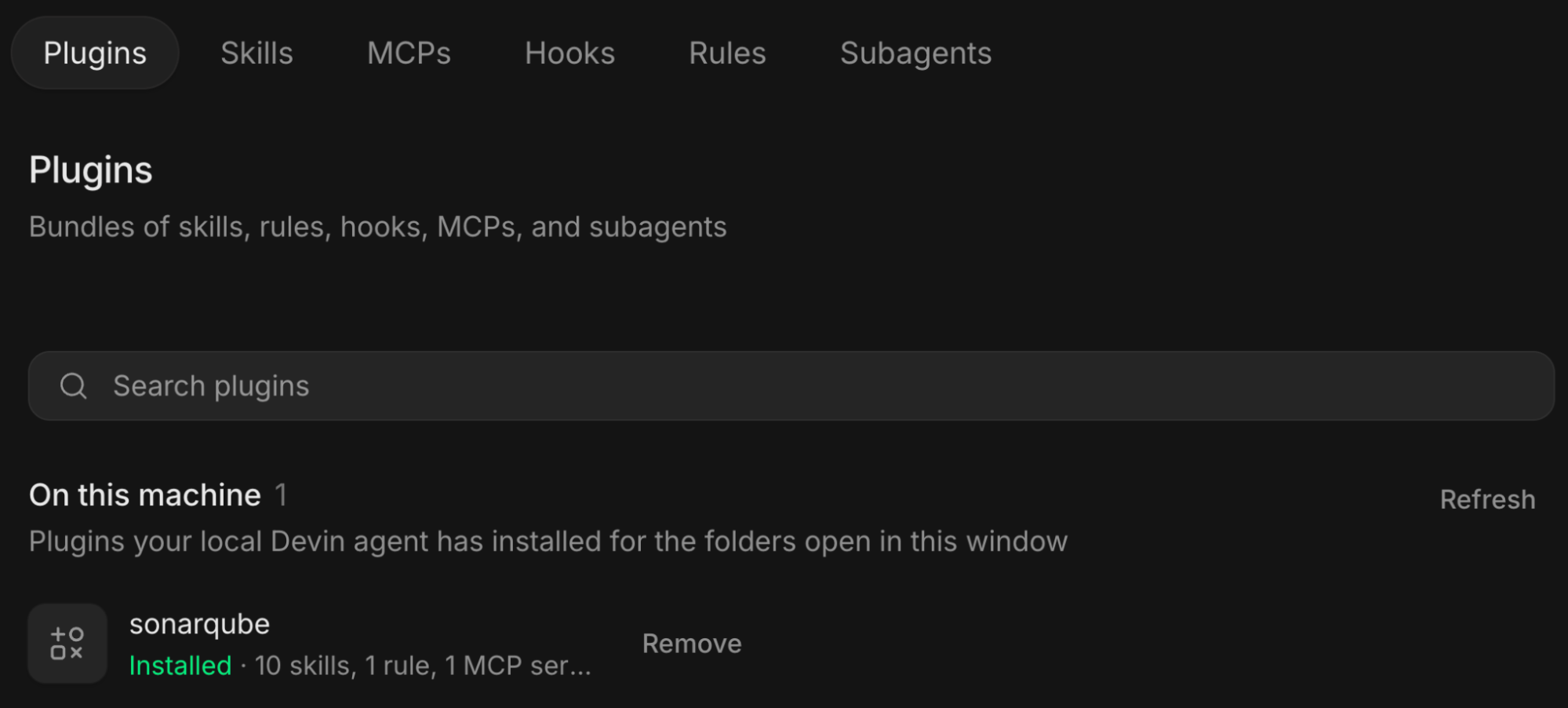
At this point the plugin is loaded, but nothing is yet wired up.
Step 2 — Configure the integration
Open the project in Devin Desktop, start a new Devin Local session, and run the integration skill, invocable via the following slash command:
/sonarqube:sonar-integrateIt walks four checks:
- CLI check — verifies the SonarQube CLI is installed and current. If it isn't already on your machine, the skill walks you through the installation step by step.
- Auth check — runs
sonar auth status. If you're already authenticated to SonarQube, it skips ahead. - Auth login — If you’re not already signed in, choose SonarQube Cloud (EU or US) and enter your organization key, or choose SonarQube Server and enter its URL. Run the
sonar auth logincommand the skill provides and complete sign-in in your browser. The CLI saves your user token in your OS keychain. - Integration — runs
sonar integrate devin --non-interactive, which installs secrets hooks, Vortex, and the SonarQube MCP Server configuration. The skill doesn't ask whether to install for the current project or globally, because the install is always global.
Devin Desktop may ask you to approve the shell commands the skill runs.
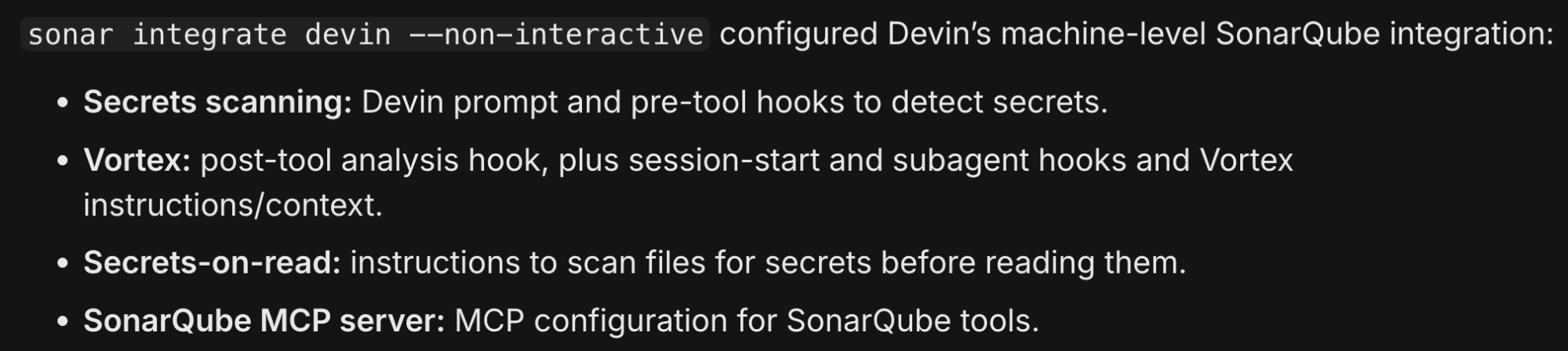
Restart Devin Desktop before continuing. Hooks and MCP configuration load when Devin starts.
Step 3 — Review what the integration configured
This step covers the artifacts that the integration contributed. All of them live outside your project, and Devin Desktop and Devin CLI both read them:
~/.config/devin/
├── config.json        # hook registrations
├── mcp_config.json    # SonarQube MCP Server entry
├── AGENTS.md          # managed Vortex analysis protocol
└── hooks/             # wrapper scripts called by the hooks
~/.sonar/sonarqube-cli/
├── bin/               # secrets analyzer and Vortex context binary
└── state.json
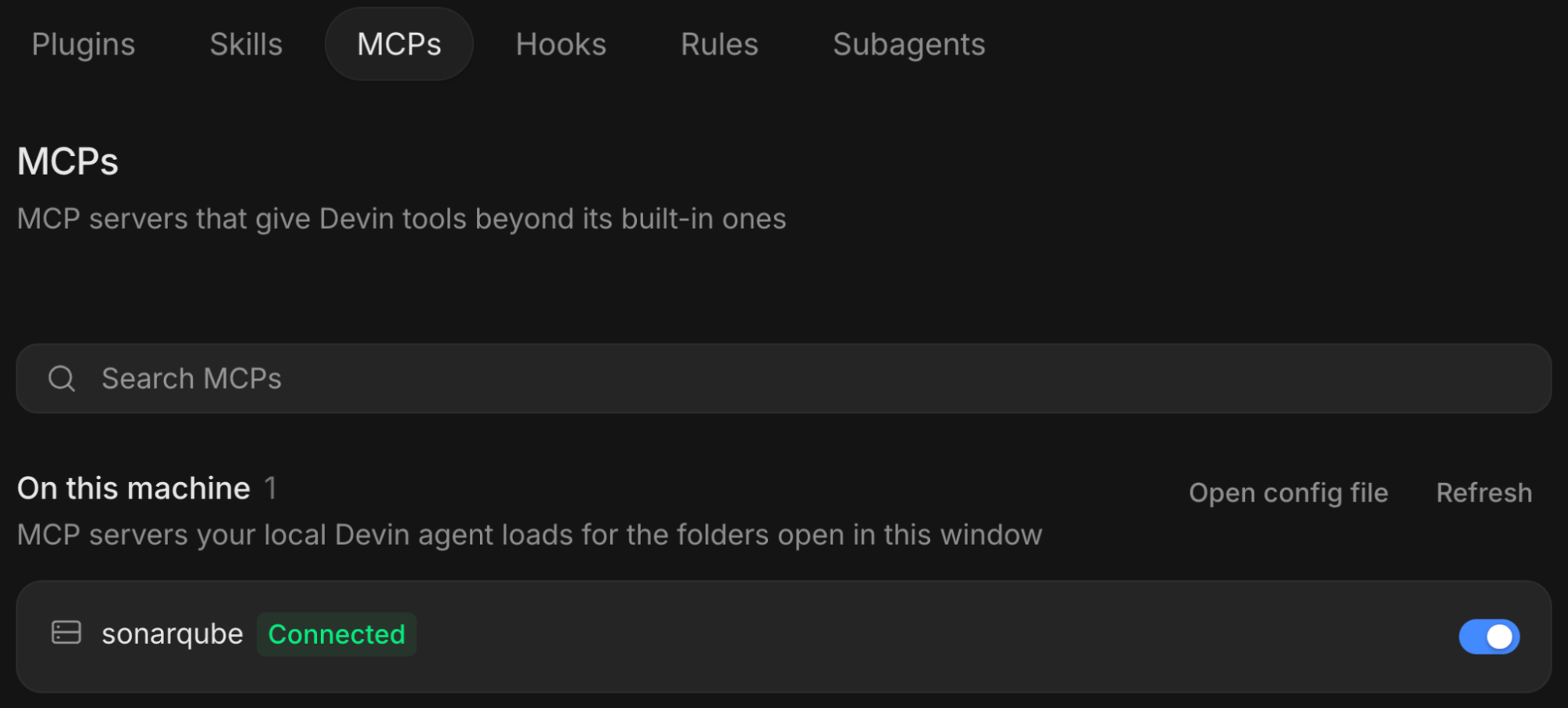
After the restart, the Customize panel shows what the agent loaded:
mcp_config.json registers the MCP server for every project:
{
    "mcpServers": {
      "sonarqube": {
        "command": "sonar",
        "args": ["run", "mcp"]
      }
    }
  }
The server starts through the CLI rather than a raw docker run, which is how the CLI detects your container runtime and hands off the keychain session. The registration is global, so it carries no project key.
~/.config/devin/config.json holds the hook registrations. This entry runs the secrets check before every file read:
{
    "hooks": {
      "PreToolUse": [
        {
          "matcher": "^read$",
          "hooks": [
            {
              "type": "command",
              "command": "'<home>/.config/devin/hooks/sonar-secrets/build-scripts/pretool-secrets.sh'",
              "timeout": 60
            }
          ]
        }
      ]
    }
  }
Five hooks are registered in total:
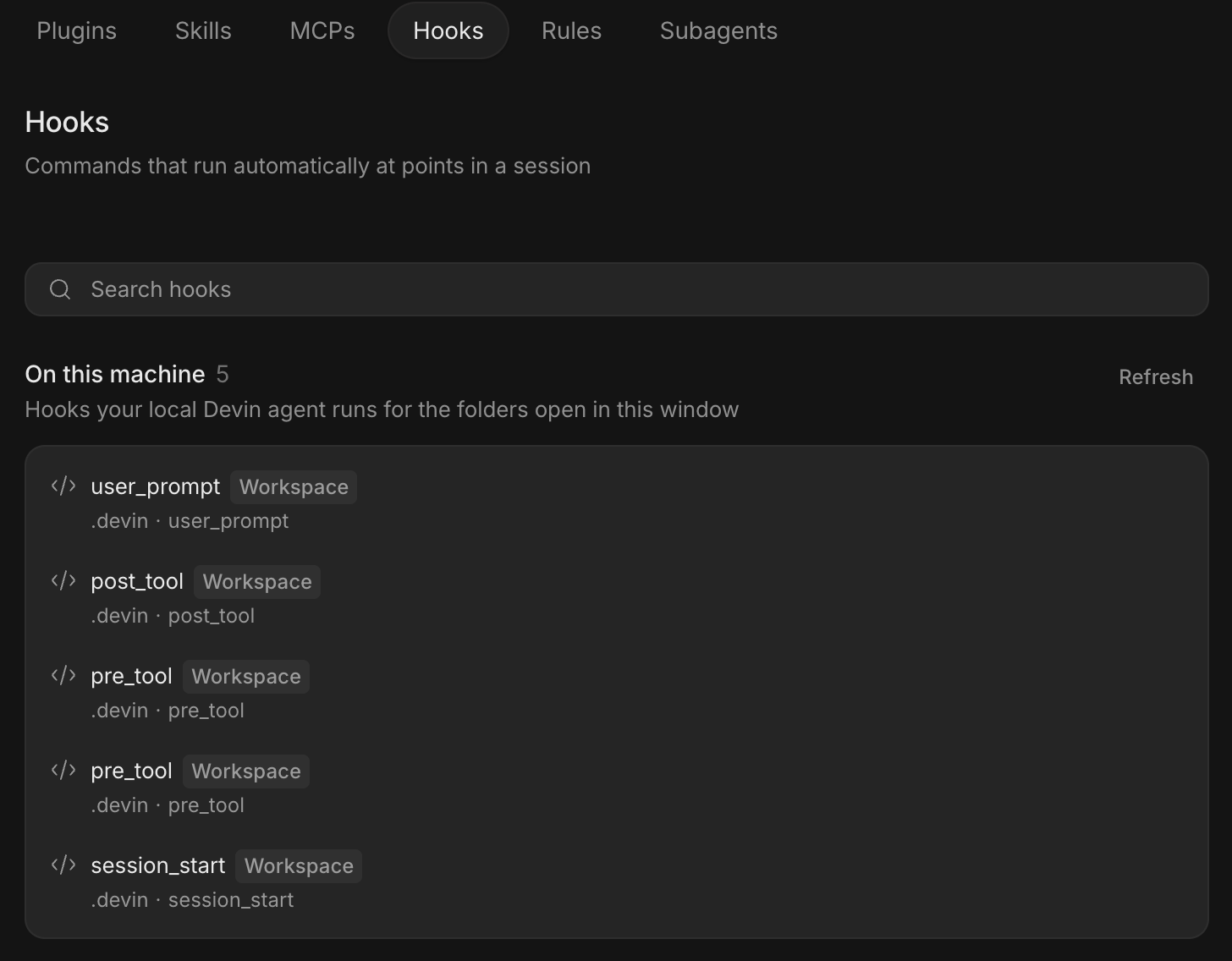
The scripts live in ~/.config/devin/hooks/, grouped into sonar-secrets/, sonar-vortex/, and sonar-sqaa/. On macOS and Linux, each one is a short wrapper that exits quietly if sonar isn't on your PATH (on Windows, the config directory is %APPDATA%\devin and the scripts differ):
#!/bin/bash
if ! command -v sonar &> /dev/null; then
  exit 0
fi
sonar hook devin-pre-tool-use
~/.config/devin/AGENTS.md carries one managed instruction block, delimited by marker comments. The sonarqube-agentic-analysis-protocol block tells Devin to run one analysis at the end of any turn that changed files:
sonar analyze agentic --depth DEEP --file <path/to/file1> --file <path/to/file2>You can omit --project and --branch: the CLI analyzes each file against its owning SonarQube project and uses the current Git branch when you’re on a named branch. Rerunning sonar integrate devin leaves your own instructions in AGENTS.md intact. SonarQube CLI 1.11.x could add a devin-secrets-on-read block to Devin’s AGENTS.md. Starting with 1.12.0, the CLI no longer adds that block and removes it on upgrade or when you rerun sonar integrate devin.
The SonarQube CLI also keeps its analyzer binaries in ~/.sonar/sonarqube-cli/bin/ and its integration state in ~/.sonar/sonarqube-cli/state.json.
Step 4 — Guide the agent with project-aware context and constraints
You don't need to invoke Vortex context directly. Give the agent a natural language prompt and watch as it draws from the context injected at session start.
what are the coding guidelines for this project?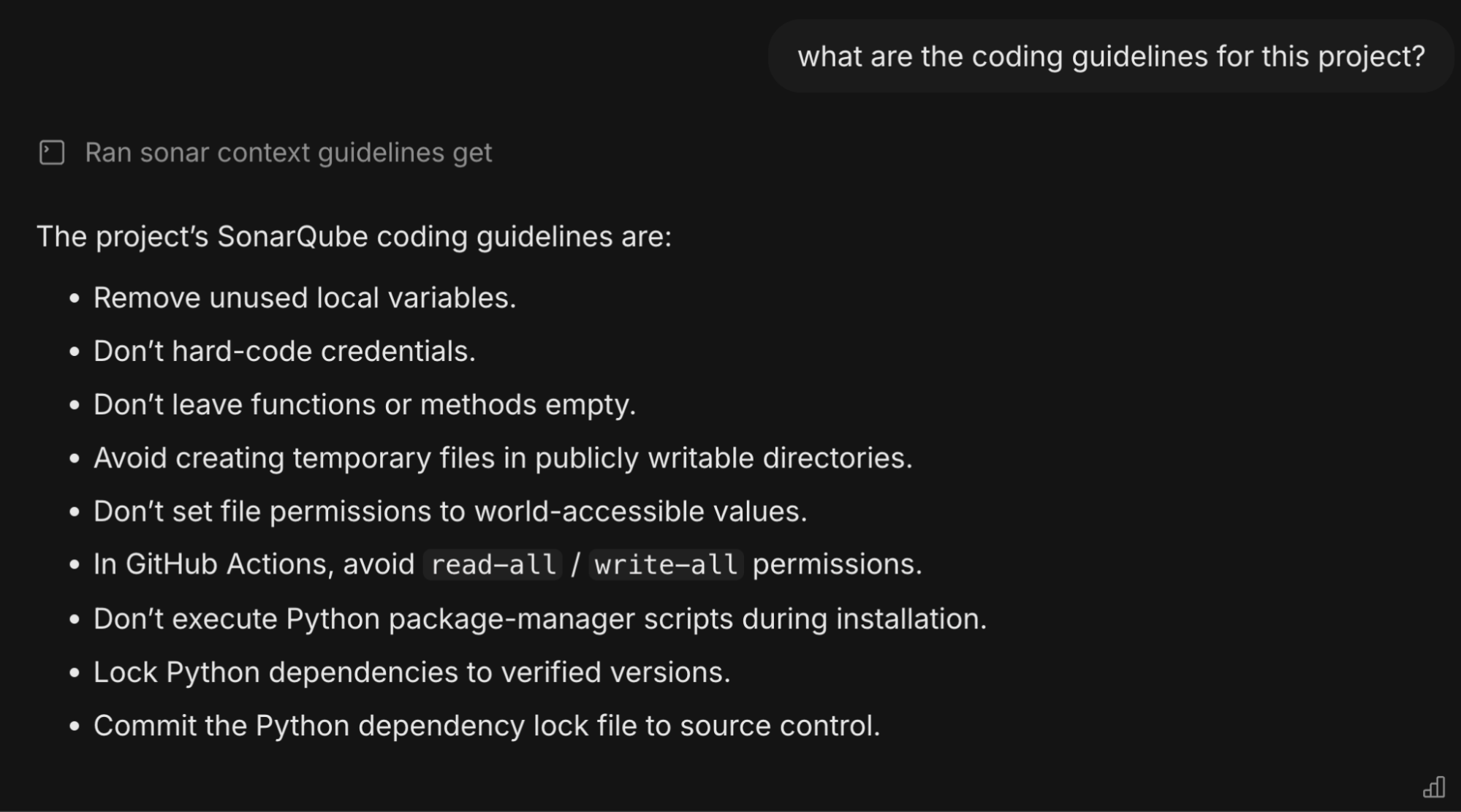
The agent returns guidelines specific to this codebase, not generic Python advice. Each one derives from the project's real SonarQube issue history, filtered by what the agent is about to do.
Now the second query:
show me the top-level architecture of this project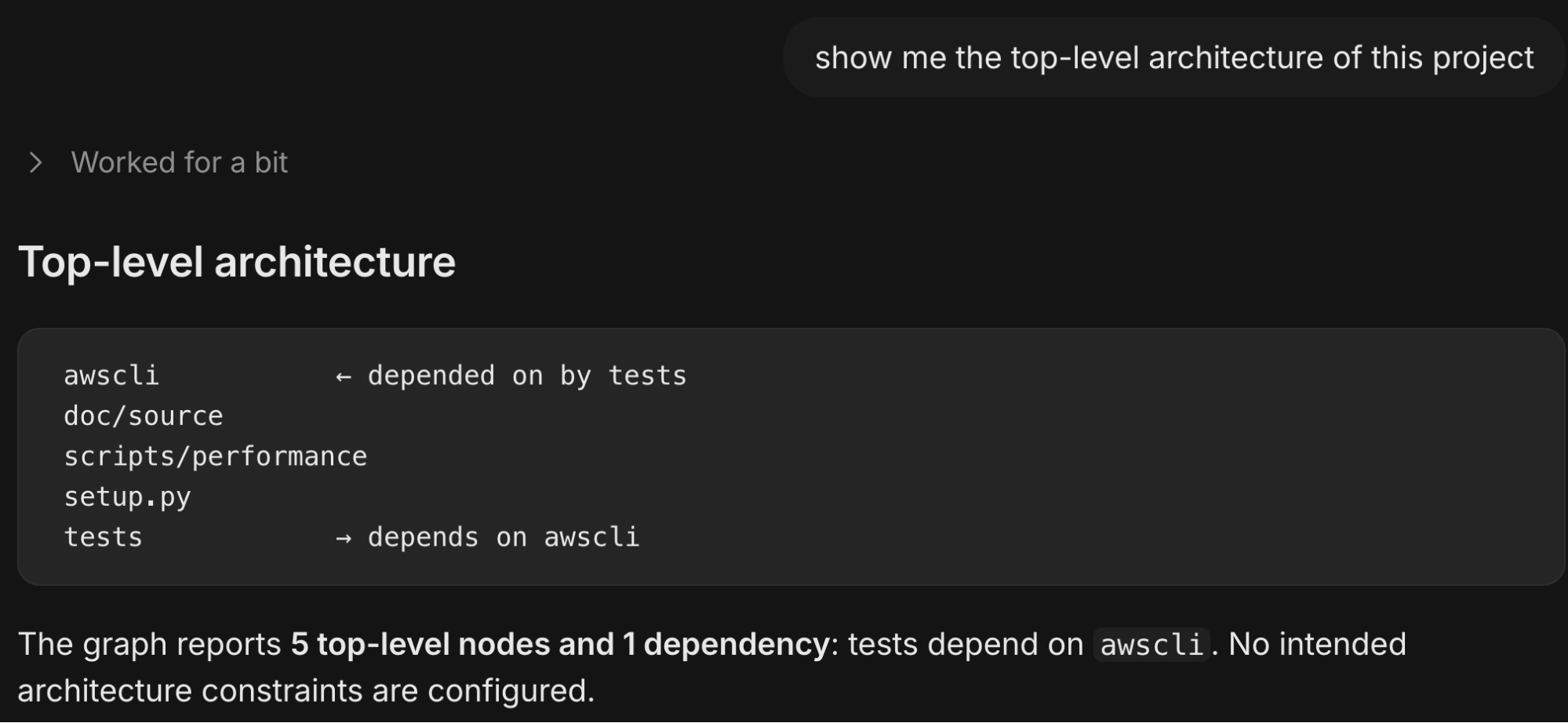
The agent describes the module layout of the awscli package from the project's dependency graph.
Four capability categories back these answers. Coding guidelines come from issue history. Architecture exposes the current dependency graph and any architectural constraints you've defined. Semantic navigation resolves call stacks, class hierarchies, and references using abstract syntax trees and control flow rather than keyword matching. Dependency health checks, where SonarQube Advanced Security is available, assess vulnerabilities, supply-chain malware, and license compliance before a package gets added.
Step 5 — Verify the agentic loop
One prompt exercises the whole loop. Ask Devin to create a new file:
Add s3_helper.py at the project root with an upload_with_retry(
bucket, key, file_path, max_retries=3
) function.

Implement a small boto3-based S3 upload helper using the standard upload_file transfer
API. Retry transient upload failures with exponential backoff, log each attempt, and
raise a clear error after all retries fail. Keep the public function signature as
specified. Include a TODO for adding metric emission later.
Devin plans the work, retrieves the project's coding guidance, and writes s3_helper.py along with a unit test file. The PostToolUse hook fires on the write with no prompting and returns findings to the agent. The agent then runs the DEEP pass its AGENTS.md protocol requires. sonar analyze agentic exits with code 51 when it finds issues, which Devin reads as a signal to act. Devin Desktop may ask you to approve the shell commands Devin runs along the way.
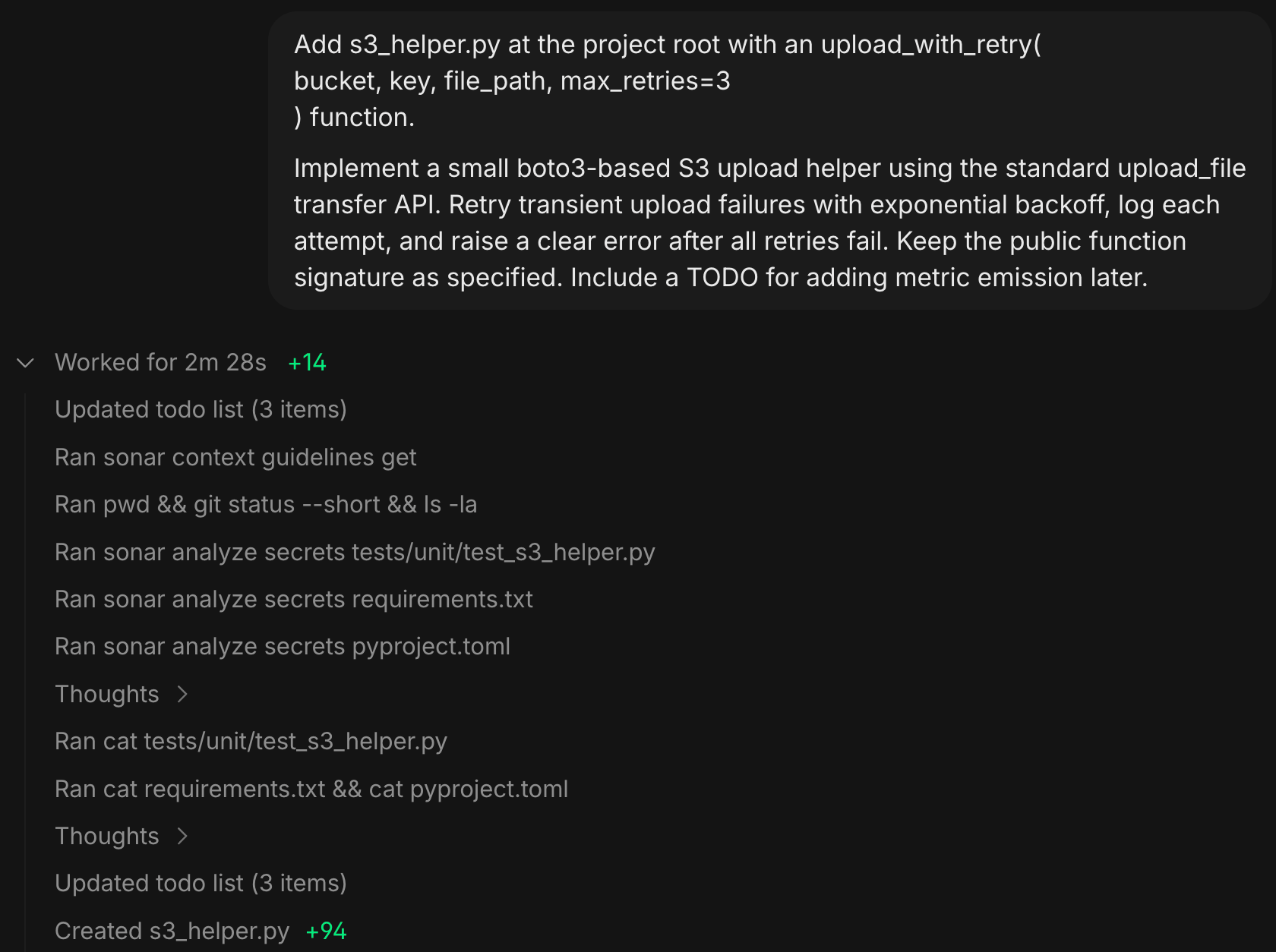
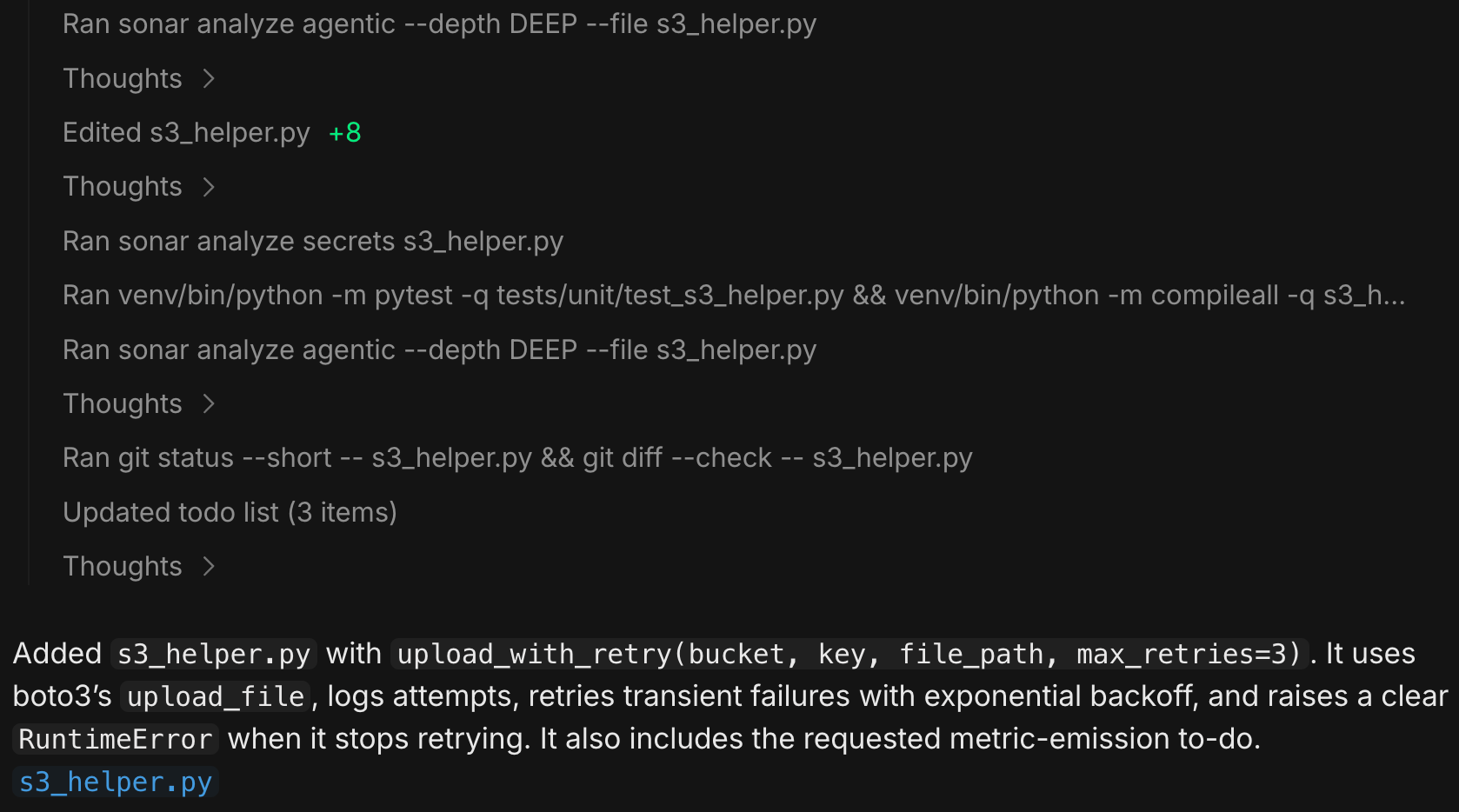
The first finding is python:S7608, which raises when an S3 operation runs without verifying bucket ownership through the ExpectedBucketOwner parameter. The agent resolves it by passing ExpectedBucketOwner through ExtraArgs, and it keeps the TODO because you asked for it. A rerun clears python:S7608, and the only remaining finding is the intentional TODO, python:S1135.
There are two key points to take away from the loop. First, the depths differ by moment: the hook runs STANDARD automatically on each edit, while the AGENTS.md protocol requires an explicit DEEP run before the agent sends its final reply. Second, the division of labor holds throughout: Vortex flagged and the model fixed, inside a single turn, with nobody reviewing a diff in between.
Step 6 — Run multi-file DEEP analysis
Single-file analysis won't catch issues that only appear across file boundaries. In the integrated terminal, pass repeated --file flags to widen the scope:
sonar analyze agentic --file awscli/clidriver.py --file s3_helper.py --file awscli/customizations/s3/subcommands.py3 files analyzed · 3 with issues · 12 issues found · DEEP analysisawscli/clidriver.py and s3_helper.py each carry one finding, the TODO marker. awscli/customizations/s3/subcommands.py carries ten that were already tracked in SonarQube, so the agent leaves them alone. Analysis reports pre-existing issues on files you didn't touch.
Four things govern this command:
- Two or more
--fileflags activateDEEPautomatically. A single file defaults toSTANDARD, and--depthaccepts either value. --projectand--branchare inferred from your project configuration and git when you run inside the project directory.- Above 50 changed files, the CLI asks for confirmation.
--forceskips the prompt. Oversized requests are split into batches, which can reduce cross-file context. - The exit code is 51 when issues are found and 0 when the analysis is clean.
Verify the setup
Run through this checklist to confirm every layer is live.
sonar auth status        # authenticated session against SonarQube
sonar system status      # integration, MCP server, and Vortex status
sonar --version          # 1.11.0 or later
docker ps --filter "ancestor=sonarsource/sonarqube-mcp"
Then, in a fresh Devin Local session in Devin Desktop:
- The
sonar-skills appear on the Skills tab under Customize, and the five Sonar hooks appear on the Hooks tab. sonarqubeis listed on the MCPs tab, and asking List my SonarQube projects returns your project list. Context tools won't appear; Vortex context runs through the hooks and the local tool, not MCP. If the server doesn't connect, runsonar auth statusand check the container runtime.- Asking What is the current architecture of the project returns your project's module layout.
- A prompt containing a credential-shaped string, or a read of a file containing one, is stopped by the secrets hooks.
- A file edit triggers the
PostToolUsehook and returns findings, and a turn that changes files ends with aDEEPpass.
Your machine should now carry these artifacts, none of them inside your project:
What to know
- Both Vortex capabilities restore stored CI analysis context. Without a prior CI analysis on a long-lived branch, results degrade, and Java projects analyzed through Automatic Analysis return only basic results.
- The integration is global and applies to every Devin project on your machine. Without a Vortex subscription, the Vortex components are skipped, and
sonar system statustells you which case applies. When a usage limit is reached, the hooks stay installed and analysis pauses until usage resets. - Language coverage differs per capability. Vortex analysis spans 25 languages including Python, but taint analysis is limited to Java, JavaScript, TypeScript, C#, and VB.NET, and semantic navigation to Java, C#, JavaScript, TypeScript, Python, and Rust.
- Secrets checks cover prompts and the
readtool only. Output from other tools, such as a shell command that prints a file, isn't scanned, and hooks don't run in Restricted Mode, so treat the hooks as a safeguard, not a guarantee. - Restart Devin after you integrate. If MCP shows as failed or not started, check that your container runtime is running, then restart. Re-running
sonar integrate devinin your home terminal refreshes the managed blocks and fixes drift, and running it interactively and choosing Customize removes the integration.sonar system statusis the fastest check on whether the Vortex subscription is active. - If your organization restricts MCP access, ask your Devin administrator to confirm that MCP is enabled and that the SonarQube MCP Server is permitted by your organization’s policy.
Last verified: November 2026, on macOS.
Next steps
Related Sonar guides:
- How to set up Sonar Vortex in Codex
- How to set up Sonar Vortex in GitHub Copilot CLI
- How to set up Sonar Vortex in Claude Code
- Set up the SonarQube plugin for Devin CLI
- Introducing Sonar Vortex and the SonarQube Remediation Agent
- The future is AC/DC: the Agent Centric Development Cycle
Consult the docs: