
TL;DR overview
- Code review is the practice of systematically examining source code to identify defects, ensure adherence to standards, and share knowledge across the team.
- Effective code review combines three layers: human judgment on logic, design, and intent; deterministic static analysis for objective quality and security checks; and, increasingly, agentic AI review that reasons about context and intent.
- Automated code review with static analysis tools complements peer review by catching common bugs and vulnerabilities before reviewers invest their time.
- AI code review goes further: it reads a change the way a person would, and the most advanced tools generate and commit real fixes rather than just flagging issues.
- SonarQube automates detection of objective code quality and security issues with algorithmic, auditable analysis. Gitar AI Code Review adds agentic reasoning that catches functional and logic issues, analyzes the build and iterates until the CI passes - together freeing human reviewers to focus on higher-order judgment calls.
What is a code review?
Code review is a software quality assurance process where one or more persons or tools systematically examine and evaluate the source code of a program. One or more of the individuals reviewing the code need to read the code and identify any issues within the code.
The goal of code reviews is to identify bugs, improve code quality, and follow best practices and standards for coding.
Code reviews are typically performed before integrating the code into the main branch of the codebase and can also be done periodically for existing code to maintain its quality over time.
The process of code review helps catch errors early in the software development lifecycle (SDLC), fosters collaboration among team members, and ultimately leads to a more robust and reliable software product.
There are code review tools that can assist with automating the review process. These review tools can check for coding errors and provide recommendations for improving the code.
If the code review is performed manually, at least one of the individuals should not be the author of the code.
What is a peer code review?
Peer code review is a software development process in which one or more developers examine code generated by a peer before merging it into the main repository. This method is intended to improve software quality, detect defects and vulnerabilities early, share expertise among team members, and ensure coding standards are followed.
Peer code review can be done in a variety of ways, but the primary method is for the reviewer to read the code and look for errors. The code reviewer may also question the author about the code in order to better grasp its intent.
What is an automated code review?
An automated code review is a process in which static code analysis tools or AI code review tools are used to automatically review and analyze the source code for potential issues and coding standard violations. Automated code review accelerates the identification and resolution of code issues and improves code quality (reliability, security, maintainability).
Different from peer review where a human is manually looking through code line by line, automated code reviews utilize tools to detect a wide range of errors from bugs and vulnerabilities to styling issues. As compared to manual peer review, automated code review tools can quickly and efficiently scan codebases to identify defects, security vulnerabilities, coding style violations, and other potential problems.
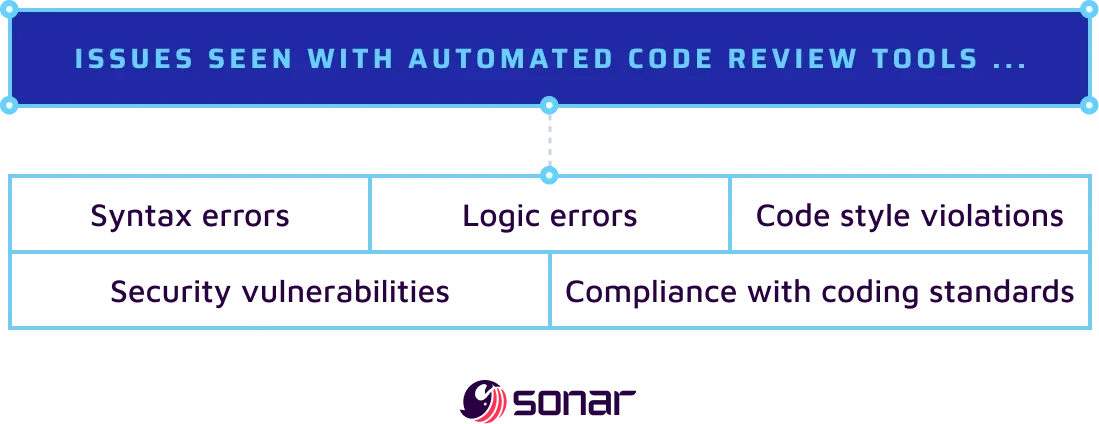
Some common issues normally highlighted with automated code review tools include:
- Syntax errors
- Logic errors
- Security vulnerabilities
- Code style violations
- Compliance with coding standards
These kinds of code inspections are essential in current DevOps and Continuous Integration/Continuous Deployment (CI/CD) processes.
What is AI code review?
AI code review is a newer category that uses large language models and agentic reasoning — rather than a fixed rule set — to evaluate a change. Instead of matching code against a catalog of known patterns, an AI code review tool reads a pull request closer to the way a person would: it builds context from the surrounding codebase and team conventions, then looks for issues that only make sense in that context — logic errors, incorrect assumptions, missed edge cases, and behavior that technically compiles but doesn't do what the author intended.
The most advanced tools in this category go a step further than leaving comments. Agentic AI code review platforms, such as Gitar AI code review, don't just flag a problem — they generate a working fix, and commit it to the branch. Gitar also monitors CI pipelines directly, roots out the cause of failing builds, and posts a fix or a clear explanation of what broke and why,and then iterates until the build passes, all without the developer leaving their pull request.
AI code review doesn't replace deterministic static analysis or human review — each looks at the code through a different lens:
- Deterministic static analysis (for example, SonarQube) checks code against a defined rule set and quality gate: consistent, fast, fully auditable, and unaffected by how the code was written.
- AI code review (for example, Gitar AI code review) reasons about intent and context, catching functional and behavioral issues a fixed rule set can't anticipate, and can act on what it finds by proposing and committing fixes.
- Human reviewers weigh in on architecture, trade-offs, and product intent — decisions that require judgment no tool fully automates.
Why is a code review important?
Code review is an important method for increasing software quality. It can aid in the detection of defects and errors, the improvement of code readability, security, and maintainability, and the exchange of knowledge early in the development process. By implementing code reviews earlier in the development life cycle, you can save time and money later on in the process.
By utilizing code reviews earlier on also, it can be made easier for future developers to work on and understand the code that is evaluated. This helps promote knowledge and collaboration among team members along with fostering shared code ownership.
What is a secure code review?
Secure code review is a subset of code review that focuses on detecting potential security flaws and weaknesses in a codebase. Its goal is to ensure that the application’s codebase is resistant to potential security threats and follows secure coding practices. It's a proactive strategy that aids in the detection and correction of security flaws before the application goes live. This can prevent attackers from exploiting weaknesses in the code.
Secure code review can be performed manually, by a security professional or developer reviewing the code line by line, or automatically, with secure code review tools that scan the code and flag errors. The code reviewer looks for common security issues in the code such as injection flaws, Cross-Site Scripting (XSS) vulnerabilities, and authentication and authorization issues.
Secure code review is an important aspect of the software development lifecycle (SDLC) since it can assist in identifying and correcting security flaws before they are exploited by attackers. The reviewer looks over code to identify known vulnerabilities like those mentioned in the OWASP Top 10 along with concerns unique to the application or dev environment.
Typically, the process includes both manual and automated reviews. Manual reviews can evaluate the logic and design of the code, identifying issues that other tools may overlook. Automated tools rapidly scan vast codebases for common vulnerabilities and coding errors, increasing the efficiency of the review process.
How to do a code review step-by-step
Code reviews are an essential element of the software development process that can considerably improve the final product's quality.
Here's a step-by-step guide to performing a code review:
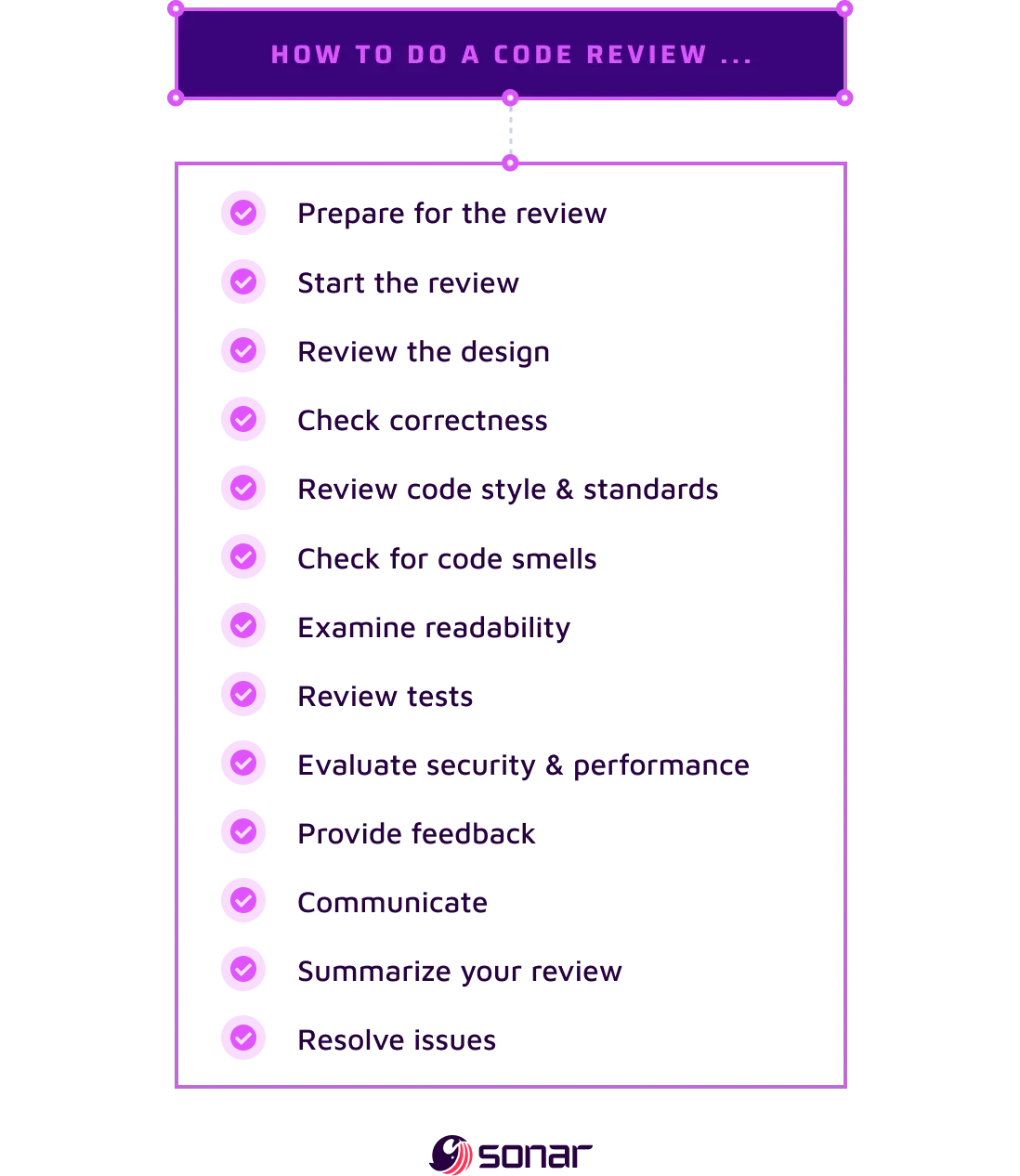
Prepare for the review
Set some time aside to become accustomed to the code before beginning the review. This includes reading the code, knowing its purpose, what the code is supposed to do, and comprehending the team's coding standards.
Understanding the goal and context of the code modification is critical.
Start the review
You can begin the review once you are familiar with the code. The review should be a two-way dialogue between you and the code's author. You should ask the author questions regarding the code, and they should explain their decisions.
Review the design
Determine whether the suggested solution is consistent with the application's existing architecture and design patterns. If the implementation diverges significantly, it is worthwhile to demonstrate why and how the alternate solution improves the project.
Check correctness
Ensure that the code functions as expected and achieves its intended goal. This could include manually executing and testing the code, examining automated test results, or simply confirming that appropriate testing was performed.
Look for any problems as you go through the code. This involves searching for logic mistakes, security flaws, performance difficulties, and readability issues.
Review code style and standards
The code should follow the coding style and standards of the team. Code style consistency makes the code easier to read and understand. This includes correct indentation, naming conventions, and code organization.
Check for code smells
Code smells can indicate more serious issues in the code. Large classes or methods, redundant code, magic numbers, or excessive complexity are examples. If you notice a code smell, it's worth talking about and possibly refactoring.
Examine Readability
The code should be easy to read and understand. Good code usually is self-explanatory.
Review tests
Ideally, code changes should be accompanied by tests. Ensure that there is appropriate test code coverage and that the tests are testing the functionality correctly.
Evaluate security and performance
Analyze the code for possible security vulnerabilities and performance issues. If the code adds new features, make sure they don't have an adverse effect on the application's performance or security.
Provide feedback
When you notice problems, give clear, constructive comments. Explain what's wrong, why it's a problem, and, if possible, provide a solution. Be courteous and professional in your remarks.
Communicate
If you have any concerns or questions, don't be afraid to ask them. It is preferable to clarify uncertainty rather than make assumptions. Code review is more than just looking for bugs; it's also an opportunity for discussion and learning.
Summarize your review
When you're through, write a summary of your findings. Depending on the conclusion of your review, you can approve the modifications, suggest revisions, or just include comments.
Resolve issues
After reviewing your suggestions, the developer should be able to remedy the issues. This could include changing the code or justifying their decisions.
The purpose of a code review is not only to find problems but to promote sharing knowledge, cooperation and continuous learning with the team. When executed properly, code review may greatly enhance the quality of your code.
Where does AI code review fit in?
Steps like checking correctness, reviewing style and standards, spotting code smells, and evaluating security and performance can happen automatically and continuously: deterministic tools like SonarQube apply your quality gate on every commit, and agentic tools like Gitar AI code review automatically read the full pull request for functional and logic issues and commit fixes directly. That leaves reviewers more time for the parts of this list that stay inherently human — reviewing design intent, having the two-way dialogue with the author, and making the final call to approve.
What are code review tools?
Code review tools are software applications that help in the code review process. These tools work to improve the organization, efficiency, and effectiveness of code reviews by including capabilities such as side-by-side comparisons, automated analysis, commenting systems and integration with version control systems.
Here are a few factors to think about when selecting a code review tool:
- The project's size and complexity. Larger and more sophisticated tasks may necessitate the use of more powerful tools.
- The available budget. Some code review tools are open source and free, while others are not.
- The functions provided by the tool. Some tools provide more features than others.
- The tool's ease of use. Some tools are more user-friendly than others.
Code review tooling generally falls into three categories:
- Version control platforms such as GitHub, GitLab, Bitbucket, and Azure DevOps, which use pull requests or merge requests as the mechanism for review.
- Deterministic static analysis tools such as SonarQube, which apply a defined, auditable rule set and quality gate to every change.
- AI-native review agents such as Gitar AI code review, which read a pull request in full context, flag functional and logic issues rule-based tools miss, and can generate and commit fixes directly on the branch.
What are automated code review tools?
Automated code review tools are software applications that analyze code automatically to find bugs, security flaws, and coding standards violations. These tools employ static code analysis, which examines the code without running it. The major purpose of these tools is to improve the efficiency of the code review process by spotting common errors, allowing human reviewers to focus on more difficult areas of the code.
What are the benefits of automated code review tools?
The following are some benefits of utilizing automated code review tools:
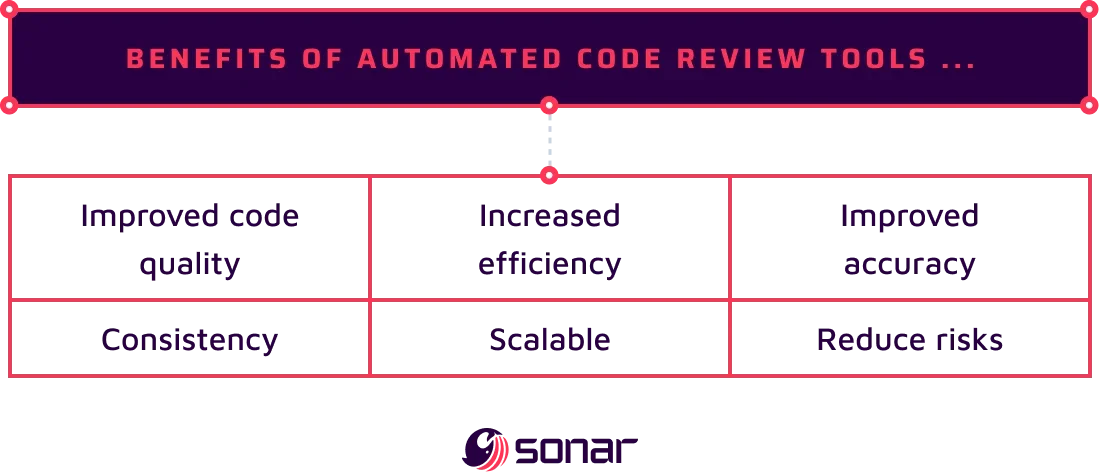
Improved code quality
Automated code review tools can greatly enhance code quality by identifying common programming errors, code smells, and potential security vulnerabilities.
Increased efficiency
Automated code review tools assist in making the code review process more efficient. This is due to the fact that they can scan code far faster than a human reviewer across multiple codebases.
Improved accuracy
Automated code review tools can improve code review accuracy. This is due to their ability to detect potential flaws and weaknesses that a human reviewer may overlook.
Consistency
These tools enforce the same rules to all code in the same way, ensuring that coding standards and guidelines are followed consistently throughout the project.
Scalable
You can scale dramatically because these tools can handle code reviews for massive codebases where manual reviews cannot. They excel at such workloads and is one of the primary advantages of using automated tools.
Reduce risks
Automated code review tools can reduce the risk of errors and vulnerabilities in source code. This is because they may detect possible issues before they are put into production.
What does AI code review add beyond static analysis?
- Fixes, not just findings — the best in class examples generate a working patch and commits it, instead of leaving a comment for someone to act on later.
- Context the rule set can't capture — reasons about what a change is trying to do, catching functional and behavioral issues static rules aren't written to find.
- Closes the loop on CI — monitors pipelines, root-causes failures, and iterates on a fix until the build is green.
- Faster time to trusted merge — shortens review cycles and reduces the back-and-forth that stalls pull requests, especially across time zones.
How do SonarQube & Gitar AI code review work together?
Code review sits at the center of how Sonar helps teams ship trusted software faster. Sonar brings together two complementary tools — SonarQube and Gitar AI code review — that, combined with your team's own judgment, cover the full spectrum of what a change needs before it merges.
SonarQube
SonarQube is Sonar's static analysis product for continuous code quality and security inspection, available as SonarQube Server (self-managed) or SonarQube Cloud (cloud-based, with automatic analysis and pull request decoration built in). It applies a consistent, auditable, algorithmic rule set across 40+ programming languages to catch bugs, code smells, and security vulnerabilities before merge, and supports custom rules and plugins so teams can extend it to their own standards. It works the same way regardless of who — or what — wrote the code.
Gitar AI code review
Gitar AI code review is Sonar's agentic AI native code reviewer. It reviews every pull request with full context of the codebase and team conventions, catching functional bugs, logic errors, and behavioral issues that rule-based tools aren't built to see. When it finds a problem, it doesn't just comment — it generates a real fix and commits it to the branch. Gitar also monitors CI pipelines and automatically analyzes failures on every PR, identifying root causes and pushing fixes. It works across GitHub, GitLab, Bitbucket, and Azure DevOps, with feedback appearing inline on the lines that have issues, summarized in a dashboard comment, and grouped into a single review — no context switching to external tools.
Why combine them
SonarQube and Gitar look at the same code through different lenses. SonarQube's algorithmic, first-principles analysis is fast, consistent, and fully auditable; it doesn't assume AI-generated code is correct, and it verifies every change against your quality gates regardless of how the code was produced. Gitar adds contextual reasoning on top of that — understanding what a change is trying to do — and can act on what it finds by proposing and committing fixes. A green CI build alone doesn't mean code is production-safe; layering both approaches means more of what matters gets caught before it ships, closing gaps that neither approach closes alone.
Used together, they free human reviewers to spend their time where judgment matters most: architecture, trade-offs, and intent, rather than re-checking what a tool could have already verified.
Start your free trial
Verify all code, then turn findings into fixes automatically. Start with Gitar in your PR, and pair it with SonarQube to find and fix issues faster.
Get started with SonarQube Install Gitar AI code review free
